Επιβεβαίωση Ηλικίας
Πρέπει να είστε τουλάχιστον 18 ετών για να αποκτήσετε πρόσβαση σε αυτό το περιεχόμενο.
Αυτός ο ιστότοπος περιέχει πληροφορίες σχετικά με ερευνητικά πεπτίδια και φαρμακολογικές ουσίες αποκλειστικά για εκπαιδευτικούς σκοπούς.
Η αναφορά ουσιών δεν συνιστά προτροπή ή σύσταση για ανθρώπινη κατανάλωση ή αυτοχορήγηση.
Επιβεβαιώνετε ότι είστε άνω των 18 ετών;
The 20 Amino Acids
The 20 proteinogenic amino acids are the building blocks of all peptides and proteins. They are encoded by the genetic code and classified according to the chemical properties of their side chain (R group).
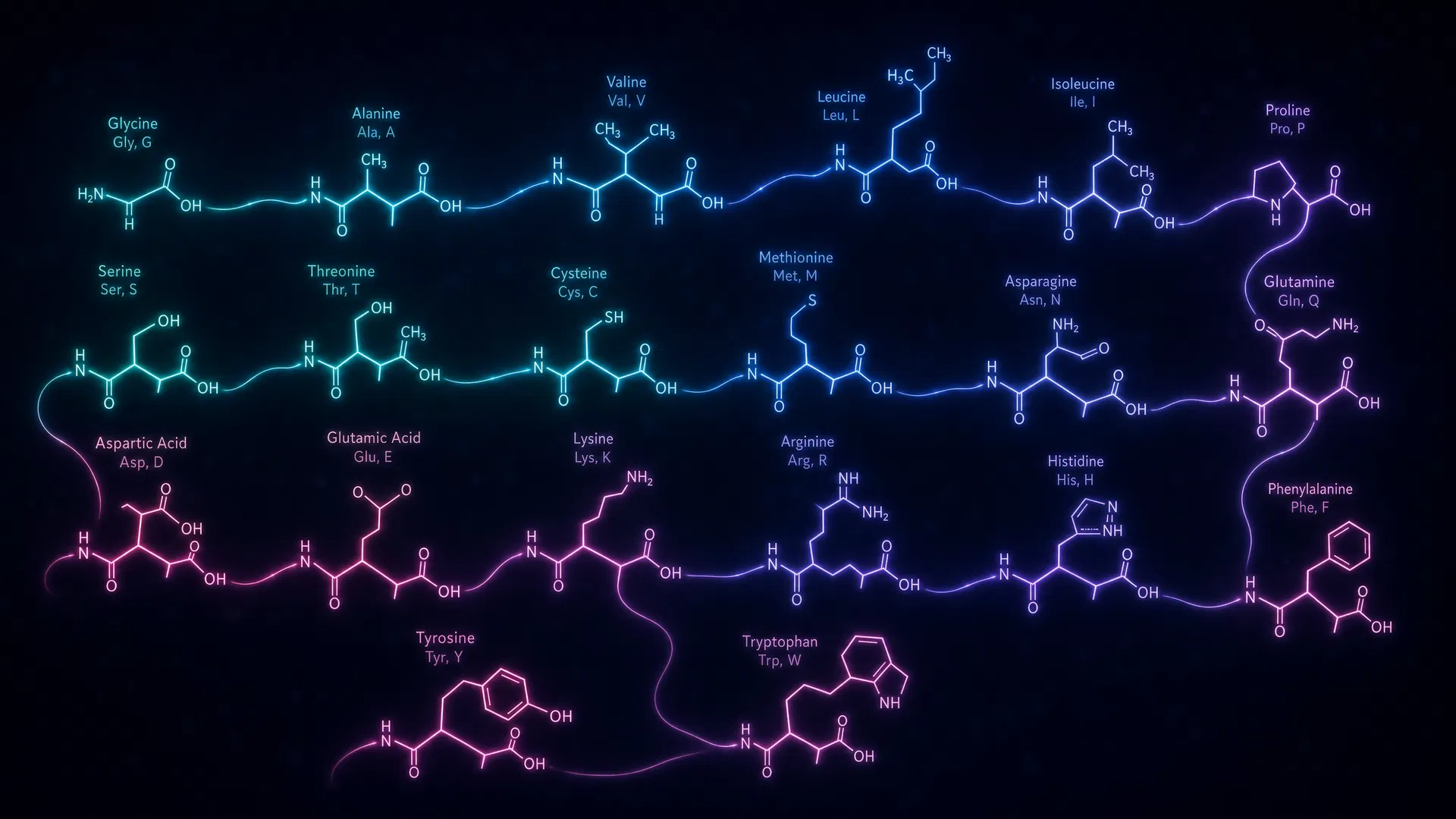
| Code | Abbrev. | Name | Property | MW (Da) |
|---|---|---|---|---|
| G | Gly | Glycine | Nonpolar | 75.03 |
| A | Ala | Alanine | Nonpolar | 89.09 |
| V | Val | Valine | Nonpolar | 117.15 |
| L | Leu | Leucine | Nonpolar | 131.17 |
| I | Ile | Isoleucine | Nonpolar | 131.17 |
| P | Pro | Proline | Nonpolar | 115.13 |
| F | Phe | Phenylalanine | Nonpolar | 165.19 |
| W | Trp | Tryptophan | Nonpolar | 204.23 |
| M | Met | Methionine | Nonpolar | 149.21 |
| S | Ser | Serine | Polar Uncharged | 105.09 |
| T | Thr | Threonine | Polar Uncharged | 119.12 |
| C | Cys | Cysteine | Polar Uncharged | 121.16 |
| Y | Tyr | Tyrosine | Polar Uncharged | 181.19 |
| N | Asn | Asparagine | Polar Uncharged | 132.12 |
| Q | Gln | Glutamine | Polar Uncharged | 146.15 |
| D | Asp | Aspartic acid | Negatively Charged | 133.10 |
| E | Glu | Glutamic acid | Negatively Charged | 147.13 |
| K | Lys | Lysine | Positively Charged | 146.19 |
| R | Arg | Arginine | Positively Charged | 174.20 |
| H | His | Histidine | Positively Charged | 155.16 |
Peptide Bond
The peptide bond forms through a condensation reaction between the carboxyl group (-COOH) of one amino acid and the amino group (-NH₂) of the next, releasing a water molecule. It is a covalent bond with partial double-bond character due to resonance, making it planar and rigid.
Classification
Amino acids are classified by their side chain properties: nonpolar (hydrophobic), polar uncharged, positively charged (basic), and negatively charged (acidic). This classification determines their position in protein tertiary structure — nonpolar residues tend to cluster in the interior, while charged residues face the aqueous environment.